
 |
India Pulse | January 29, 2026: Your Daily Digest of India's Governance, Progress, and Vision
The India Pulse Newsletter for January 29, 2026 covers FM Sitharaman tabling Economic Survey 2025-26 in Parliament, India hosting India-Arab FM meet on January 31, Delhi government approving Rs. 728 crore schemes to fast-track development in Trans-Yamuna region, Scindia outlining telecom roadmap for connectivity to gram panchayats, Railways completing 100M long ‘Make in India’ steel bridge for Mumbai-Ahmedabad Bullet Train project, SAIL earning Great Place to Work certification for third consecutive time, and Beating Retreat ceremony concluding 77th Republic Day celebrations.
NEWS IN DETAIL
Sitharaman Tables Economic Survey 2025-26 In Parliament
Union Minister for Finance and Corporate Affairs Nirmala Sitharaman tabled the Economic Survey 2025-26 in Parliament on Thursday.
Highlights
First Advance Estimate Projects Real GDP Growth And GVA Growth For Fy26 To 7.4 And 7.3 Per Cent Respectively
Potential growth for India estimated at around 7 per cent, while real GDP growth for fy27 projected at 6.8-7.2 per cent
Centre’s revenue receipts rose to 9.2% Of GDP in FY25 (PA)
GNPAs reach multi-decadal low of 2.2%in September 2025
55.02 crore bank accounts opened as of march 2025 under PMJDY, with 36.63 crore in rural and semi-urban areas
Number of unique investors cross the 12-crore mark in September 2025, with nearly 25 per cent being women
India’s share of global merchandise exports nearly doubles from 1% to 1.8% between 2005 and 2024
Services exports touch an all-time high of USD 387.6 billion in FY25, growing by 13.6%
India remains the world’s largest recipient of remittances, with inflows reaching USD 135.4 billion in FY25
India’s foreign exchange reserves increase to USD 701.4 billion as of 16th January 2026, providing cover for 11 months imports and 94% of external debt
Domestic inflation averaged 1.7 per cent for April-December, 2025
India’s foodgrain production is estimated to have reached 3577.3 lakh metric tonnes (LMT) in agriculture year (ay) 2024–25, an increase of 254.3 LMT over the previous year
More than Rs. 4.09 lakh crore has been released to eligible farmers under PM-KISAN since its inception
VIKSIT BHARAT-GRAMG is a comprehensive statutory overhaul of MGNEREGS aligning rural employment with long-term vision of Viksit Bharat 2047
Manufacturing GVA grow by 7.72% in Q1 and 9.13% in Q2 of FY26, reflecting structural recovery
Production linked incentive (PLI) schemes across 14 sectors have attracted over Rs. 2.0 lakh crore of actual investment, generating incremental production/sales exceeding Rs. 18.7 lakh crore and over 12.6 lakh jobs as of September 2025
India semiconductor mission has advanced domestic capabilities, with 10 projects of about Rs. 1.60 lakh crore of investment
High-speed corridors increase nearly ten-fold-from 550 km (FY14) to 5,364 km (FY26, up to December 2025); 3,500 km of railway added in fy26
India is the world’s 3rdlargest domestic aviation market, with the number of airports increasing from 74 in 2014 to 164 in 2025
Historic turnaround for discoms; recording a positive pat of Rs. 2,701 crore in FY25 for the first time
India ranks 3rd globally in overall renewable energy and installed solar capacity
India becomes the fourth nation to achieve autonomous satellite docking (spadex) capability
Gross Enrolment Ratio (GER) stands at 90.9, 90.3 and 78.7 at the primary, upper primary and secondary stages
India now has 23 IITs, 21 IIMs, and 20 AIIMS, alongside the establishment of two international IIT campuses in Zanzibar and Abu Dhabi
India accelerated maternal and child mortality reduction since 1990, outpacing global averages
As of January 2026, the e-Shram portal has successfully registered over 31 crore unorganised workers, 54% being women
Vacancies mobilised in the national career service portal exceeded 2.8 crore in FY25 and have already crossed 2.3 crore by September FY26.
Multidimensional Poverty Index (MPI) as measured by Niti Aayog shows a decline from 55.3% in 2005-06 to 11.28% in 2022-23
Survey proposes disciplined swadeshi for strategic resilience: a calibrated three-tiered strategy that builds critical capabilities, reduces input costs, strengthens advanced manufacturing, and progresses from self-reliance to strategic indispensability.
India To Host India-Arab FM meet Jan 31
India will host the 2nd India-Arab Foreign Ministers’ Meeting on 31st January. The meeting will be co-chaired by India and the UAE.
The Foreign Ministers’ meeting is happening after a gap of 10 years, the first meeting being held in 2016 in Bahrain.
At the first meet, the Ministers identified five priority verticals of cooperation: economy, energy, education, media and culture and proposed a set of activities across these verticals.
The 2nd India-Arab Foreign Ministers’ meeting is expected to build on our existing cooperation, expanding and deepening this partnership.
India Arab Foreign Ministers’ Meeting is the highest institutional mechanism driving this partnership, which was formalised in March 2002 when India and League of Arab States signed an MoU institutionalizing the process of dialogue.
A Memorandum of Cooperation was signed for the establishment of Arab-India Cooperation Forum during the visit of the then Arab League Secretary General Amre Moussa to India in December 2008, which was subsequently revised in 2013 in terms of structural organization.
This is the first India-Arab Foreign Ministers’ meeting to be hosted by India in New Delhi and will see participation by all 22 Arab countries by Foreign Ministers, other Ministers, Ministers of State and other Senior Officials and Arab League.
Delhi Govt Approves Rs. 728 Crore Schemes To Fast-Track Development In Trans-Yamuna Region
The Delhi government has approved schemes worth 728 crore rupees to effectively accelerate the pace of development in the Trans-Yamuna region in the national capital. The budget allocation was announced by Chief Minister Rekha Gupta during the Trans-Yamuna Area Development Board (TYADB) meeting.
During the meeting, the Chief Minister stated that there would be no shortage of funds for the development of the Trans-Yamuna region.
She also instructed the board members to prioritize schemes based on need. The Chief Minister said that the development of the Trans-Yamuna area is among the Delhi government’s top priorities.
CM said that the Delhi government is prioritizing the basic needs of citizens, such as roads, drainage systems, addressing waterlogging problems, and ensuring safe transportation.
Chairman of the TYADB, Arvinder Singh Lovely, expressed his gratitude to the Chief Minister and said the proposals submitted by all Members of the Legislative Assembly for the development of the Trans-Yamuna region are important.
He said that this collective effort will prove instrumental in transforming the basic infrastructure of the Trans-Yamuna region.
Scindia Outlines Telecom Roadmap For Connectivity To Gram Panchayats
Union Minister for Communications, Jyotiraditya Scindia on Thursday informed the Rajya Sabha about the significant progress and future roadmap of the Department of Telecommunications in providing connectivity to Gram Panchayats. He underlined that BharatNet has evolved into the backbone of India’s digital transformation.
Replying to a question in the House, the Union Minister said the government’s vision is to provide world-class, fast, and reliable broadband connectivity to every citizen. He said this will enable transformative change in education, healthcare, governance, business, and employment.
He stressed that BharatNet is no longer just a connectivity project but a national digital infrastructure empowering both rural and urban India.
The Minister said nationwide Broadband Highway will be built under the BharatNet Scheme. He said fibre connectivity will reach every home with a target of 1.5 Crore Fibre To The Home, FTTH connections under the scheme.
Mumbai–Ahmedabad Bullet Train Project: Railways Complete 100M Long ‘Make in India’ Steel Bridge
Indian Railways has successfully completed the construction of a 100 metres long Make in India steel bridge over the underground metro tunnel in Ahmedabad district for the Mumbai-Ahmedabad Bullet Train Project.
The Ministry of Railways in statement on Thursday said that this is the 13th steel bridge completed in Gujarat, out of a total of 17 steel bridges planned in the state.
It added that this will strengthen the high-speed rail connectivity while ensuring the safety of existing urban transport systems.
Baikunth and Urkura Railway Line Approved
The Ministry of Railways has also sanctioned the construction of a fourth railway line between Baikunth and Urkura, covering a length of over 26 kilometres, at an estimated cost of more than 426 crore rupees, under the South East Central Railway.
The Ministry said that the Baikunth-Urkura section is a vital part of the Bilaspur-Raipur-Nagpur main line, which also falls on the Mumbai-Howrah high-density railway network, one of the busiest rail corridors in the country. At present, this section is operating with saturated capacity, underscoring the urgent need for capacity expansion.
SAIL Earns Great Place To Work Certification For Third Consecutive Time
Steel Authority of India Limited (SAIL), one of India’s largest public sector steelmakers, has earned the coveted Great Place to Work certification for the period from February 2026 to February 2027.
The Ministry of Steel informed that this is the third consecutive time the company has received the certification, following a comprehensive assessment by the Great Place to Work Institute of India.
The Ministry added that the recognition reflects SAIL’s enduring commitment to nurturing a workplace culture that is contemporary, agile, and closely aligned with the professional and personal growth of its employees.
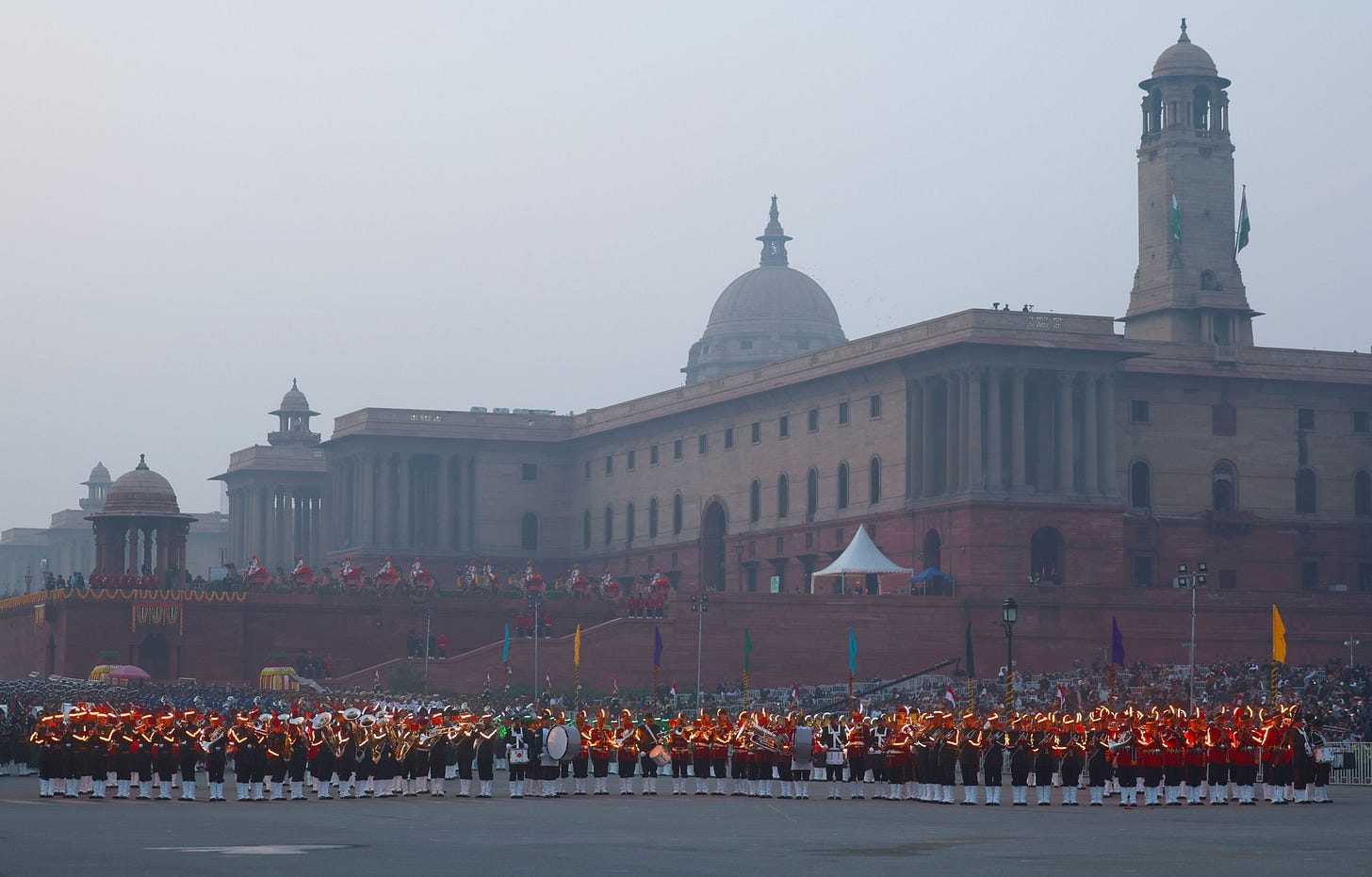
Beating Retreat Ceremony Concludes 77th Republic Day Celebrations
Beating Retreat ceremony, marking the culmination of the 77th Republic Day celebrations, was held at Vijay Chowk in New Delhi on Thursday.
The ceremony was attended by President Droupadi Murmu, Vice-President C.P. Radhakrishnan, Prime Minister Narendra Modi, Defence Minister Rajnath Singh and Union Ministers.
The bands of the armed forces mesmerized the audience by playing tunes on patriotic songs such as Vande Mataram, Bharat Ke Shaan, Aye Watan, Aye Watan and Sare Jahan Se Acha.
The ceremony also witnessed a special formation by the Indian Air Force band on Operation Sindoor, honouring the valour and sacrifice of the armed forces during the operation. It featured bands from the Indian Army, Navy, Air Force and Central Armed Police Forces.
The ceremony began with the Massed band’s Kadam Kadam Badhaye Ja followed by melodious tunes by the Pipes and Drums band such as Atulya Bharat, Veer Sainik, Mili Jhuli, Nritya Sarita, Marooni, and Jhelum.
The Central Armed Police Forces bands played Vijay Bharat, Hathrohi, Jai Ho and Veer Seepahi. The Indian Air Force played tunes including Brave Warrior, Twilight, Alert, and Flying Star, while the Indian Navy band played the tunes, including Namaste, Sagar Pawan, Matribhumi, Tejasvi, and Jai Bharati. Indian Army band played ‘Vijayee Bharat’, ‘Aarambh Hai, Prachand Hai’, ‘Aye Watan, Aye Watan’, ‘Anand Math’, ‘Sugamya Bharat’, and ‘Sitare Hind’.
This was followed by the Massed Bands which played tunes including ‘Bharat Ke Shaan, Vande Mataram and Drummers Call. The event concluded with the ever-popular tune of Sare Jahan Se Acha played by the Buglers.
This year, the seating enclosures at Vijay Chowk were named after Indian musical instruments including Bansuri, Damaru, Ektara, Esraj, Mridangam, Nagada, Veena among others, highlighting the country’s rich cultural heritage.